Etsy Fees 2026: Full Breakdown and How to Calculate Them
Etsy fees in 2026 explained: listing, 6.5% transaction, payment processing by country and Offsite Ads, with worked examples and a simple fee calculator.
Etsy marketplace consultancy for businesses in the USA and worldwide.
How to price on Etsy for profit: a simple formula that covers costs, labour and Etsy fees, plus worked examples, discount checks and market research steps.
Part of: Etsy Fees 2026: Full Breakdown and How to Calculate Them
In short: To price on Etsy, add up every cost of one order (materials or print cost, labour, packaging, shipping), add the profit you want, then divide by what's left after Etsy's percentage fees. For a US seller, that means dividing by 0.905 after adding $0.45 of fixed fees. Next, check the result against similar listings that are selling and test it. A good Etsy price still makes a profit on a discounted order or one that comes through Offsite Ads.
Last updated: 20 November 2026. Fee figures checked against Etsy's Fees & Payments Policy and Etsy Help's Payment Processing Fees page.
Pricing is the decision that quietly makes or breaks an Etsy shop. Price too low and every sale costs you time for very little money. Price too high without showing why, and buyers move on to the next listing. Most sellers we work with started by copying a competitor's price, then found out months later that it left them almost nothing after fees. It's written for handmade, print on demand and digital sellers who want a clear method they can repeat for every product.

We use five steps with every client, in this order:
The first three steps give you a price floor, the lowest price that still works. The last two tell you how far above that floor buyers will go.
Sellers usually remember materials and forget the rest. Here's a complete list for one order.
| Cost | What to include | Often forgotten? |
|---|---|---|
| Materials or production | Materials used, or your print partner's base price | Rarely |
| Labour | Your time to make, pack and answer messages, at an hourly rate | Very often |
| Packaging | Box, mailer, tissue, tape, thank-you card | Often |
| Shipping | Postage, whether the buyer pays it or you include it | Sometimes |
| Etsy fees | Listing, transaction and payment processing | Often |
| Ads and discounts | Offsite Ads orders, Etsy Ads spend, sales and coupons | Very often |
| Overheads | Software, tools, samples, a share of refunds and remakes | Very often |
For overheads, take a monthly total and divide by the number of orders you expect. If your tools cost $30 a month and you expect 60 orders, add $0.50 to each order.
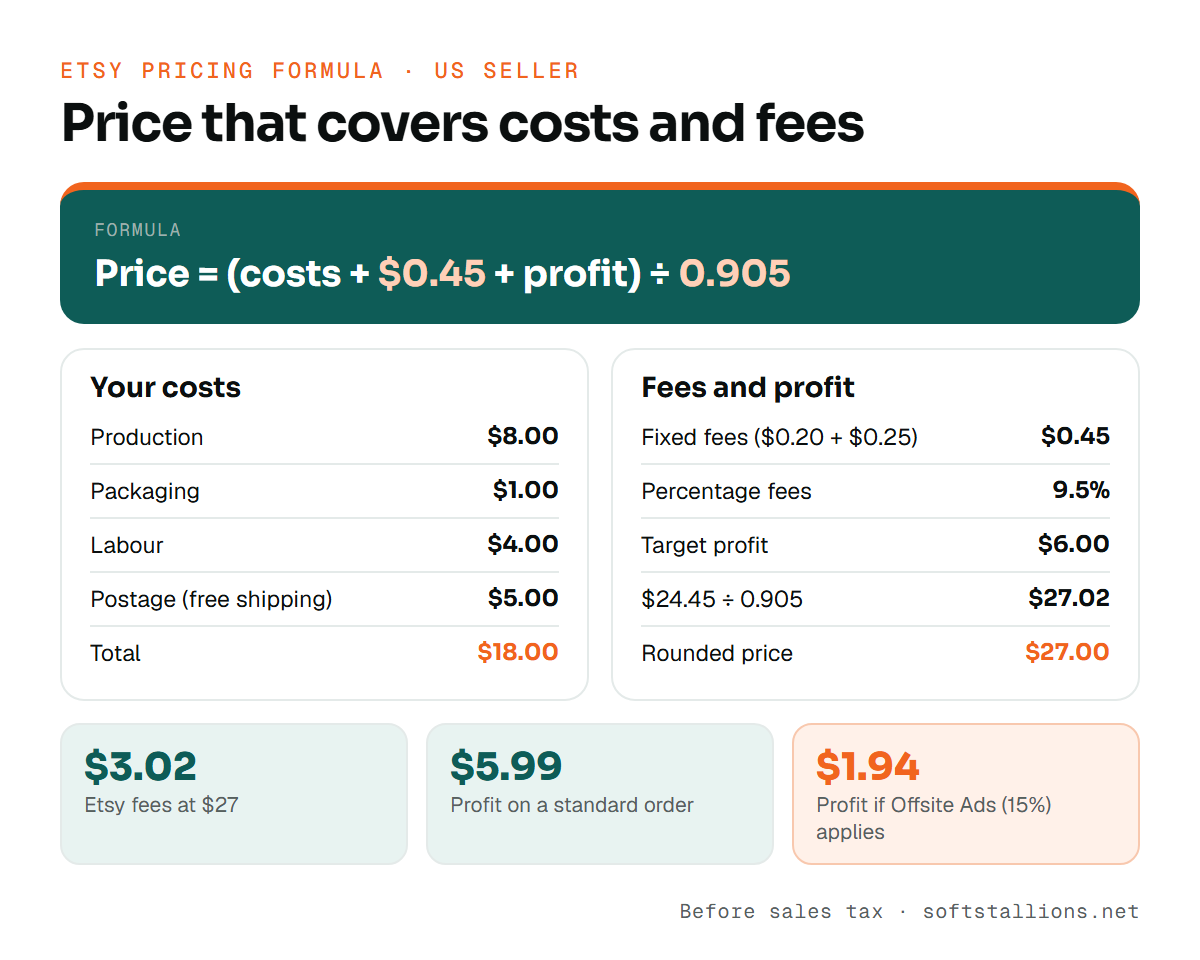
Etsy's fees are partly fixed and partly a percentage of the order. A US seller pays $0.20 for the listing and $0.25 in processing per order, plus 6.5% transaction and 3% processing on the order total. That's 9.5% in percentage fees. To build those into your price:
Price = (your costs + $0.45 + target profit) ÷ 0.905
Here's a worked example for a personalized item with free shipping:
($18.00 + $0.45 + $6.00) ÷ 0.905 = $27.02, so we would round to $27.00. At $27, Etsy's fees come to $3.02 and you keep about $5.99 profit, before sales tax. Outside the US, use your own country's processing rate in place of the 3% + $0.25, and add VAT or other fees that apply to you.
Your formula gives you the minimum. The market tells you the range. To check it:
Don't simply copy the cheapest price. You don't know a competitor's costs, and some shops sell at prices that barely cover their fees. If your floor sits above most of the market, change the product, the materials or the offer, and don't cut your profit to zero. Our Etsy competitor analysis does this research for you across your main products.

Either way, someone pays the postage, and Etsy's transaction and processing fees apply to the shipping you charge. That means the fees are the same whether $5 of postage sits in the item price or in a separate shipping charge.
The real difference is how buyers see the price. A high shipping charge that appears late in checkout can put buyers off, so we usually suggest including some or all of the postage in the item price. If you do, make sure the formula includes the full postage cost, and check your shipping profiles for international orders, where postage is often higher.
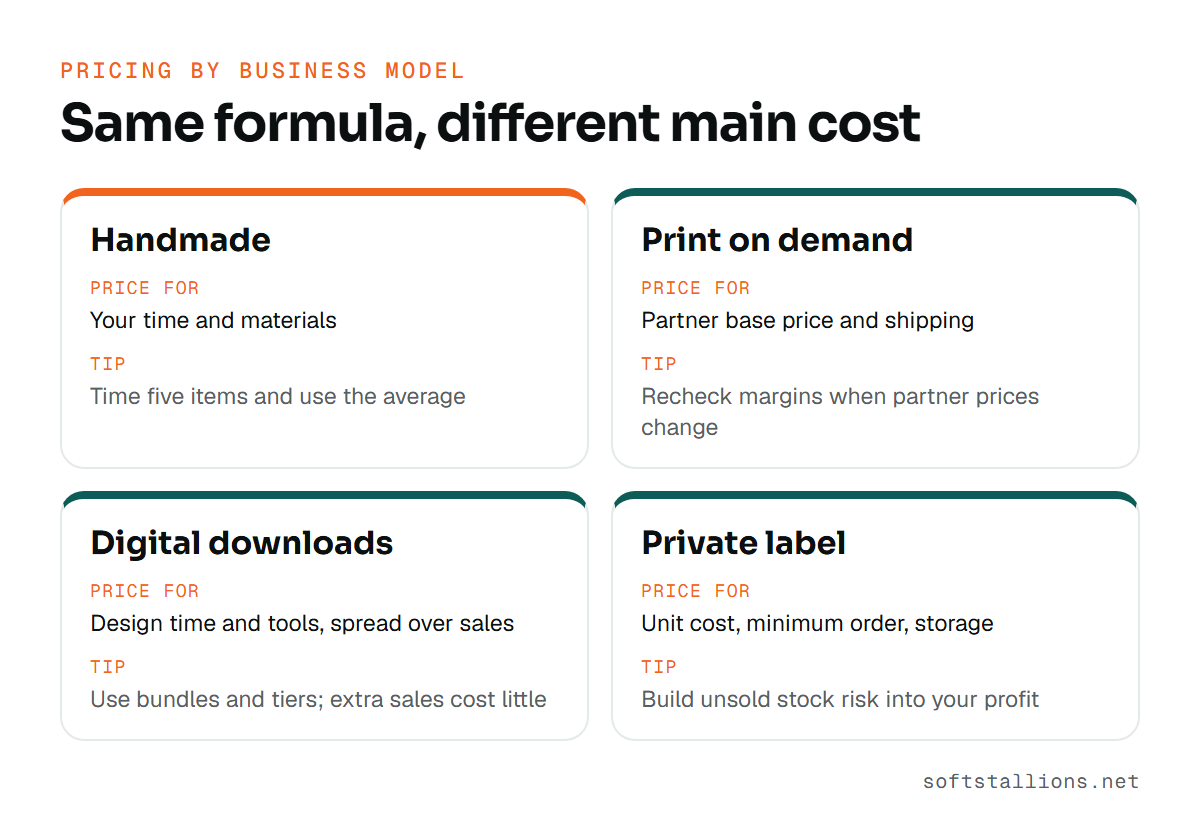
The formula is the same, but the main cost changes with the business model.
| Model | Main cost to price for | Pricing tip |
|---|---|---|
| Handmade | Your time and materials | Time yourself making five items and use the average |
| Print on demand | The print partner's base price and shipping | Recheck margins whenever the partner changes its prices |
| Digital downloads | Design time and tools, spread over expected sales | Use bundles and tiers, since each extra sale costs almost nothing |
| Private label | Unit cost, minimum order and storage | Include unsold stock risk in your target profit |
For print on demand in more depth, see our guide to print on demand pricing. If you're choosing products with pricing in mind, our Etsy product research service checks demand and price bands before you invest.
A price that only works at full price, with no ads, will lose money on some orders. Run two extra checks on every product.
Take the $27 example and run a 20% sale. The buyer pays $21.60, Etsy's fees fall to about $2.50, and your costs stay at $18. Profit drops to about $1.10. If you plan to run regular sales, set your full price so the sale price still meets a minimum profit you're happy with.
If that $27 order comes through Offsite Ads at 15%, add $4.05 in fees. Profit falls to about $1.94. To keep $6 profit on an Offsite Ads order, the price would need to be about $32.50. At $32.50, a standard order would make about $11. Shops under $10,000 in yearly sales can opt out of Offsite Ads. Once a shop passes that level, the fee drops to 12% and becomes mandatory, so plan for it.
Etsy Ads are paid from a daily budget you set. Track how many orders each listing gets from ads and divide your ad spend by those orders. If that cost per order is higher than your profit, pause the ads on that listing or raise the price. Our full Etsy fees guide lists every fee you might meet.
A single price for a single item leaves money on the table. Three ways to raise the average order without raising your base price:
Each option should still pass the formula on its own. A bundle that sells well but makes less profit per item than single sales isn't helping.

Look for these signs in your Stats and orders:
Raise prices on one or two listings first, by a small step, and compare visits, conversion rate and orders over the following weeks with the period before. If orders hold steady, the higher price is working. If they drop sharply, review the listing's photos and description before going back to the old price. If sales are slow overall, start with our guide to an Etsy shop not getting sales, because pricing is only one possible cause.
Our Etsy consulting service includes a full price review: we cost each product, run the discount and Offsite Ads checks and suggest new prices with the reasons behind them.

There's no single right number. It depends on your product and how much time each order takes. Set a minimum profit per order that makes the work worthwhile, and check that it survives discounts and Offsite Ads.
Not by default. Very low prices attract orders that don't pay for your time and are hard to raise later. Compete with better photos, clearer listings and a specific offer.
Add your costs, the fixed fees and your profit, then divide by one minus the percentage fees. For a US seller that's (costs + $0.45 + profit) ÷ 0.905.
Yes. The 6.5% transaction fee and the payment processing fee both apply to shipping charges.
Every few months, and whenever your material, postage or print partner costs change.
Free consultation · USA & worldwide
We cost every product, build Etsy's fees in and test your prices against discounts and Offsite Ads. You get clear prices with the numbers behind them.
Or see: Etsy consulting · Etsy competitor analysis · Etsy product research · Etsy print on demand
Etsy fees in 2026 explained: listing, 6.5% transaction, payment processing by country and Offsite Ads, with worked examples and a simple fee calculator.
The Etsy shop setup fee explained: what it is, why the amount varies, when you pay it, whether it is refundable, and every fee you pay after opening…
How to promote your Etsy shop outside Etsy: Pinterest, TikTok, Instagram and email, Etsy's Share & Save links, and how to track what brings real sales.