
Seasonal Print on Demand Calendar for Etsy (2026-2027)
Seasonal print on demand calendar for Etsy: real 2026-2027 holiday dates, suggested listing lead times, last order date formula and product ideas.
Etsy marketplace consultancy for businesses in the USA and worldwide.
Etsy keyword research step by step: find real buyer phrases for free, score them for intent and competition, and map one main phrase to each listing.
In short: Etsy keyword research means finding the exact phrases buyers type when they want a product like yours, then choosing the ones you can realistically rank for. Start with buyer-style seed phrases, collect real searches from Etsy's search suggestions, study the wording of top competing listings, and check your own Stats for search terms that already bring visits. Score each phrase for buying intent, fit and competition, then give every listing one main phrase and a group of supporting phrases.
Last updated: 27 October 2026. Field limits and search behavior checked against Etsy Help's How to Use Tags to Get Found in Search and Etsy's Seller Handbook articles Keywords 101 and How Etsy Search Works. Google's Keyword Planner and Google Trends are referenced as optional extra sources.
Etsy can only show your listing for a search if the listing contains words that match it. So keyword research is the first job on any listing, before you write a title or pick a single tag. This guide is for sellers who want a method they can repeat on every new product, with no paid tool needed. You'll learn how to find phrases, how to judge them, and how to map them to listings so your own listings don't end up competing with each other.
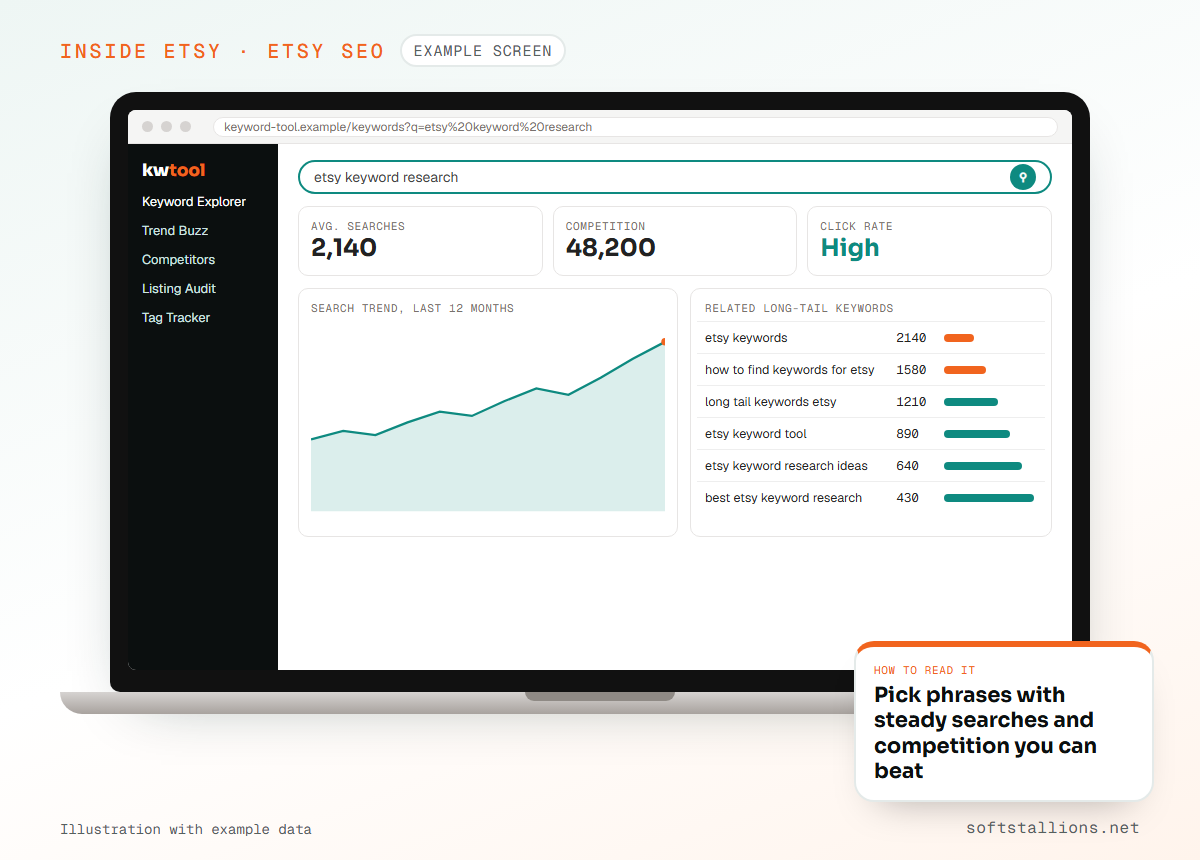
Etsy keyword research is working out how buyers describe a product when they search, then deciding which of those descriptions your listing should target. A keyword on Etsy is usually a phrase of two to five words, such as "birth flower necklace" or "teacher appreciation tote bag".
The phrase with the most searches is rarely the best pick. You want phrases that tick all of these boxes:
With those phrases in hand, the placement work comes next: titles, tags, category and attributes. Our pillar guide to Etsy SEO explains how Etsy uses each field once your research is done.
Sellers know their products from the making side. Buyers know them from the using side. A jeweller might call a piece a "hammered sterling stacking band", while a buyer types "silver stacking ring" or "thin silver ring for her". Research closes that gap.
The other common mistakes are:
You can do solid keyword research with nothing but Etsy and your own shop data. Here are the four sources we check first on client shops.
Type a phrase into the Etsy search bar and pause. The suggestions that drop down come from what shoppers actually search. Try your seed phrase followed by different letters of the alphabet, or add words like "for", "with" or "personalized" to see more variations.
Search your main phrases and open the first organic listings, skipping the ones marked as ads. Note the words that repeat across several titles. When lots of strong listings describe the item the same way, that's probably how buyers search for it.
Search results pages and category pages often show related searches and filters. These show you adjacent phrases and the attributes buyers filter by, such as color, style or occasion.
If your shop already has visits, Stats in Shop Manager lists the search terms that brought shoppers to your listings. It's the most reliable source you've got, because it's real buyer behavior on your own products.

Here's the method we use for each new product or product group. Once you've done it a few times, it takes an hour or two for a small group of related listings.
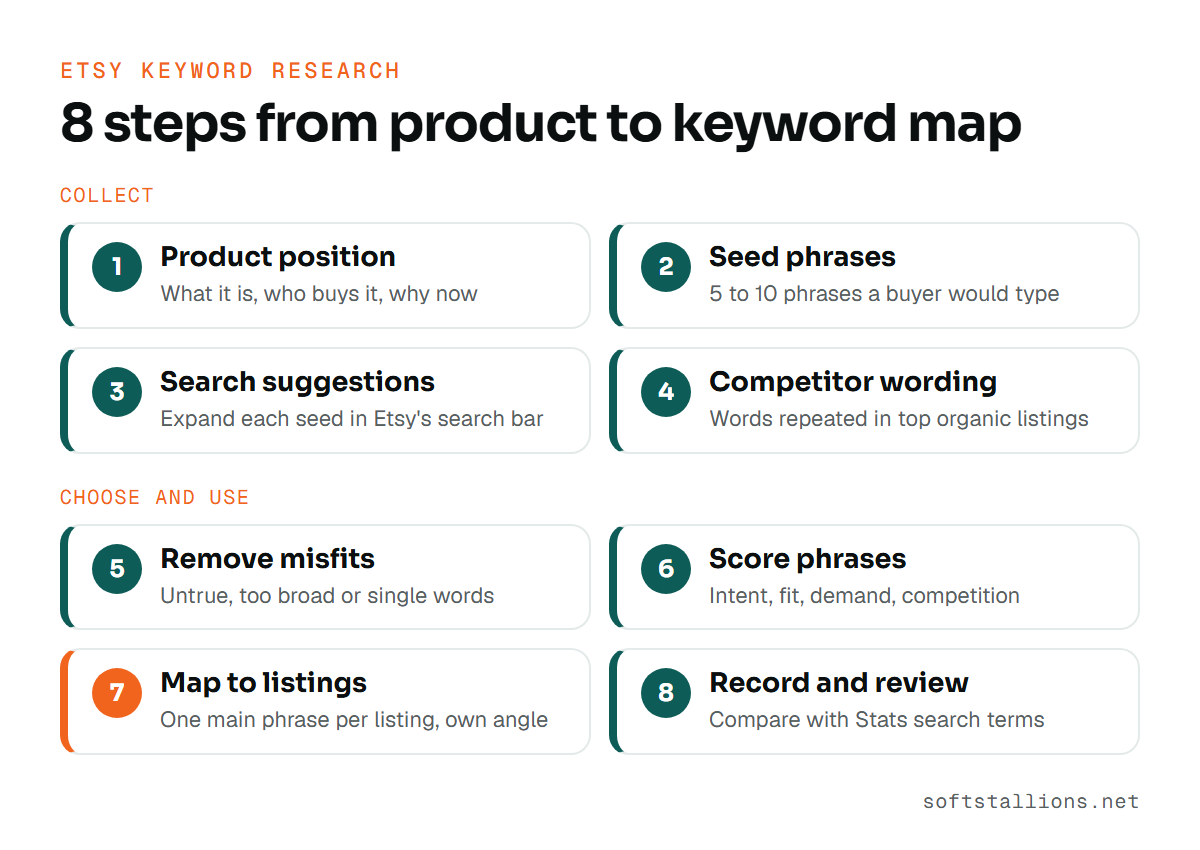
Describe the product in one sentence from the buyer's side: what it is, who it's for and why they'd buy it now. For example: "A personalized ceramic mug for dog owners, bought as a birthday gift." That one line keeps the rest of your research focused.
Write the phrases a friend might type to find this product without knowing your shop. Mix the product with the buyer, occasion and style: "dog mom mug", "custom dog mug", "pet lover birthday gift", "dog name mug".
Run each seed through the search bar and record every suggestion that fits your item. You'll often end up with 40 to 80 candidate phrases.
For your top seeds, read the titles of the leading listings. Add any new phrases you spot, and note which ones keep showing up.
Cut phrases that describe a different product, a material you don't use, or a style that doesn't match your design. Also cut single words and very broad phrases. Accuracy matters here. A phrase that doesn't describe your item brings the wrong shoppers, and they don't click or buy.
Use the scoring table in the next section to pick the strongest options.
Assign one main phrase per listing and attach supporting phrases to it. We cover this below under keyword mapping.
Keep your phrases in a simple spreadsheet next to each listing. After a few weeks, compare them with the search terms in Stats and adjust.
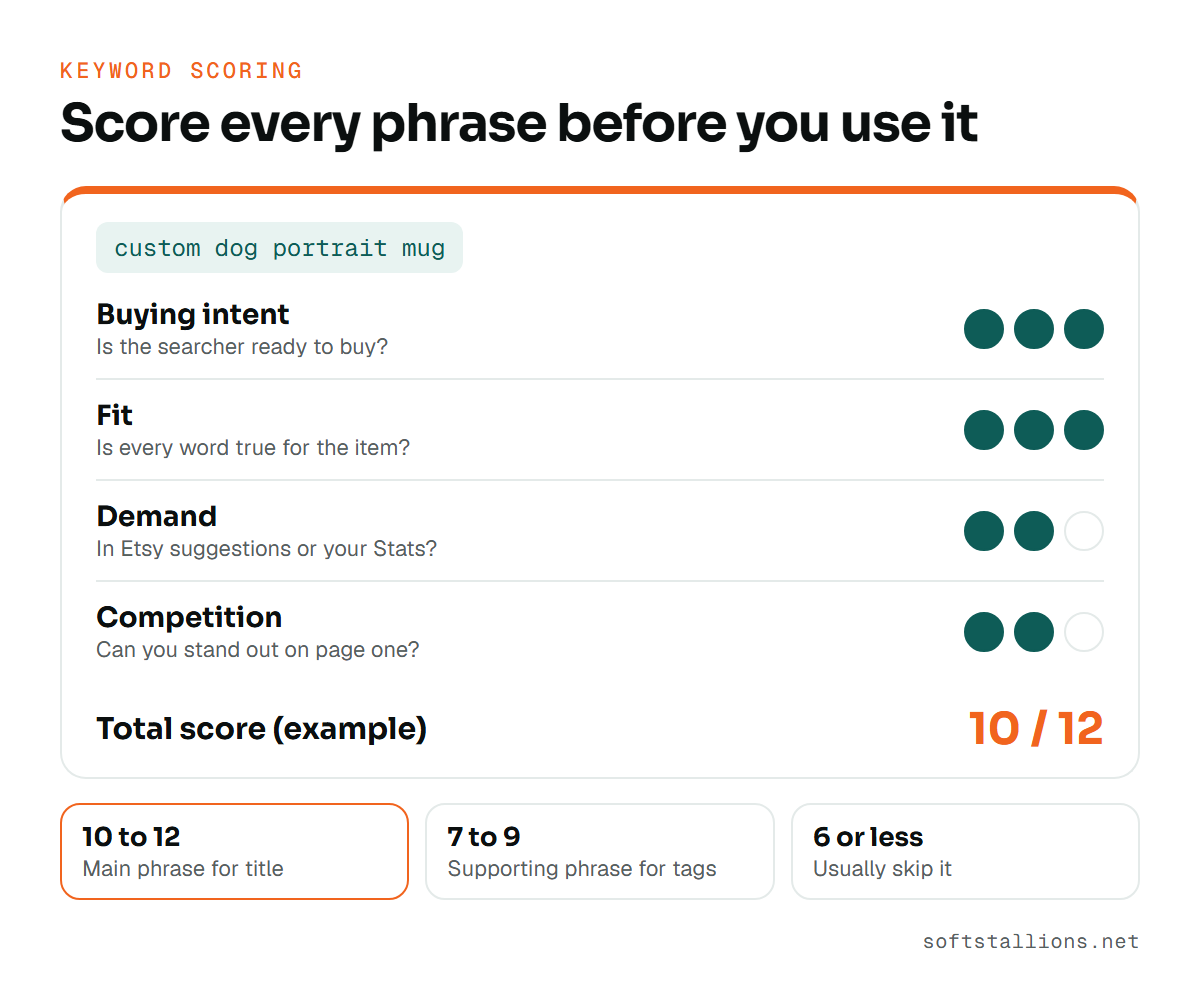
Paid tools give you search volume estimates, but you can judge phrases perfectly well without them. Score each phrase from 1 to 3 on four questions.
| Question | Score 3 | Score 1 |
|---|---|---|
| Buying intent: is the searcher ready to buy? | "personalized dog mom mug" | "how to make a mug" |
| Fit: does it describe your item exactly? | Every word is true for the item | Only loosely related |
| Demand: do people search it? | Shows in Etsy suggestions and in Stats | Nowhere in suggestions |
| Competition: can you stand out? | Top results have weak photos or vague titles | Page one is full of polished, heavily reviewed listings |
Phrases scoring 10 to 12 are main-phrase candidates. Scores of 7 to 9 make good supporting phrases for tags. Anything lower is usually not worth a slot.
For new shops, longer phrases nearly always win. Fewer listings compete for them, and the people typing them already know what they want. Once your shop builds up reviews and sales, you can start going after broader phrases.
Keyword mapping is simply deciding which listing targets which phrases. Without it, sellers often give twenty similar listings the same title pattern and the same tags, and those listings end up fighting each other for one search.
Build each listing's keyword cluster like this:
For similar products, give each listing a different angle. If you sell several dog mugs, one can target "dog mom mug", another "custom dog portrait mug" and another "dog lover retirement gift". That way each listing has its own search to compete for.
| Keyword type | Example | Where it goes |
|---|---|---|
| Main phrase | custom dog portrait mug | Start of title, first line of description |
| Synonym | pet portrait mug | Tag |
| Recipient | dog mom gift | Tag |
| Occasion | birthday gift | Occasion attribute, plus a specific tag if it fits |
| Material or color | ceramic, white | Attributes |
Our guides on choosing Etsy tags and writing Etsy titles show how to turn a cluster into finished fields.
They're useful as extra signals, as long as you use them with care. Google Keyword Planner was built for Google advertisers. It shows estimates of Google searches, not Etsy searches, so a big number there doesn't mean the same demand exists on Etsy. It's good for spotting buyer wording you hadn't thought of, and for comparing product angles.
Google Trends shows how interest in a phrase rises and falls over time. That helps you plan seasonal listings early, so they're live before buyers start searching. Our guide to Google Trends for Etsy explains how to read it.
Whatever Google tells you, confirm it on Etsy. Check that the phrase appears in Etsy's suggestions and that real listings sell for it.

No, not to start. Etsy's suggestions, competitor listings and your Stats give you real buyer language for free. Third-party tools estimate search volume and competition, which can save time once you're managing lots of listings or researching new niches often. Their numbers are estimates, though, so treat them as a guide and still check phrases on Etsy itself. Our article on Etsy SEO tools compares the main options.
Review your main listings every few months, and before each major season if you sell gifts. Signs that a listing needs fresh research:
Change a few things at a time and note the date, so you can tell what made a difference.
If you'd like this research done for your shop, our Etsy keyword research service delivers a keyword map for your listings, and our listing optimization service puts it into your titles, tags and attributes.
One main phrase, plus enough supporting phrases to fill 13 tags. The supporting phrases should describe the same item from different angles, such as recipient, occasion and style.
A longer, more specific phrase, such as "personalized birth flower necklace" instead of "necklace". These usually have fewer competing listings and attract buyers who know what they want.
You can learn from the words competitors use to describe similar items. Never use their shop names, brand names or trademarked terms, and only use phrases that truly describe your product.
In Shop Manager, open Stats. It shows the search terms shoppers used before visiting your listings, which is the most reliable keyword data you have.
Yes. Etsy advises writing tags in your shop's language. If many of your buyers use a different word for the same item, such as "jumper" and "sweater", cover both in your tags.
Free consultation · USA & worldwide
We research the phrases your buyers actually type and map one main phrase to every listing. You get titles and tags ready to use, without guesswork.
Or see: Etsy keyword research · Etsy SEO services · Listing optimization · Competitor analysis
Seasonal print on demand calendar for Etsy: real 2026-2027 holiday dates, suggested listing lead times, last order date formula and product ideas.
Etsy Black Friday 2026 planning: a timeline from August to January, what to sell, how to price a discount, set up a sale and meet holiday shipping dates.
Our Etsy shop setup guide walks you through every screen: preferences, shop name, payments, setup fee, ID check, 2FA, storefront and first listings.