Etsy Shop Setup Guide 2026: Step by Step for New Sellers
Our Etsy shop setup guide walks you through every screen: preferences, shop name, payments, setup fee, ID check, 2FA, storefront and first listings.
Etsy marketplace consultancy for businesses in the USA and worldwide.
Compare the four Etsy business models: print on demand, digital products, private label and handmade. What Etsy allows, startup costs and how to choose yours.
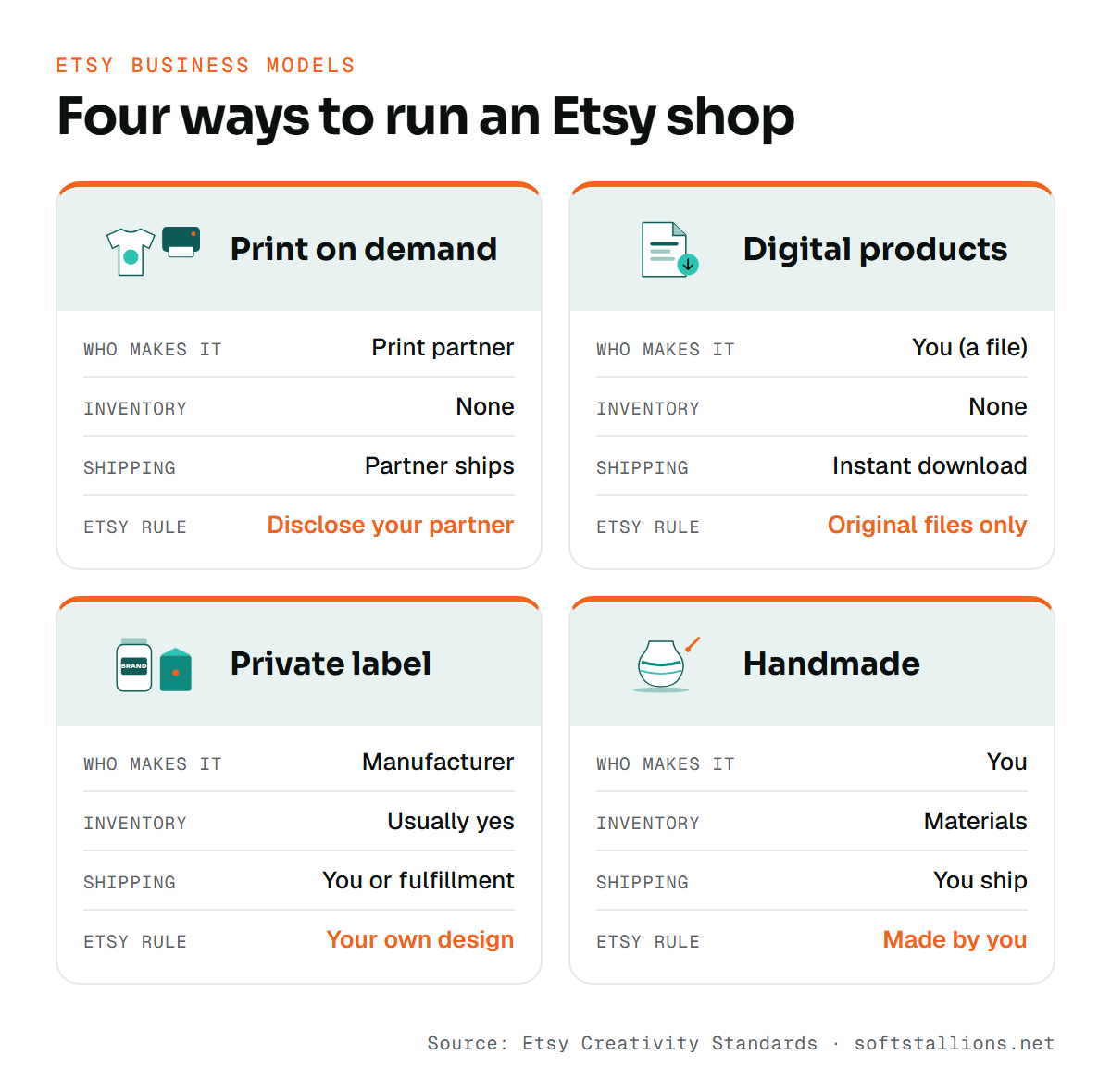
In short: There are four main Etsy business models. With print on demand, you design products and a partner prints and ships them. With digital products, you sell files that buyers download. With private label, a manufacturer makes products to your own design under your brand. With handmade, you make each item yourself. Etsy allows all four, as long as the product comes from your own design or your own hands. The right one depends on your budget, your skills and how much time each order can take.
Last updated: 27 October 2026. Etsy's rules in this guide are checked against Etsy's Creativity Standards (last updated by Etsy on 10 June 2025) and its Fees & Payments Policy.
Most people who contact us already have a product in mind: t-shirts, a planner, a skincare line, candles. The question underneath is usually bigger. How will this shop actually run day to day? Who makes the product? Who ships it? Where does the money go before any profit is left? That's what a business model answers. Pick it early and you'll save yourself a lot of rework later.
Below, we walk through each model in plain terms: what Etsy allows, what it costs to start and run, and how to pick the one that fits you.
Etsy doesn't sell everything. Its Creativity Standards say every item needs a "human touch", and they sort allowed items into four groups:
The four business models in this guide fit into the first two groups. One rule matters more than any other: Etsy does not allow you to resell ready-made products you did not make or design. A product bought from a wholesaler and relisted as-is will be removed, whatever business model you call it.
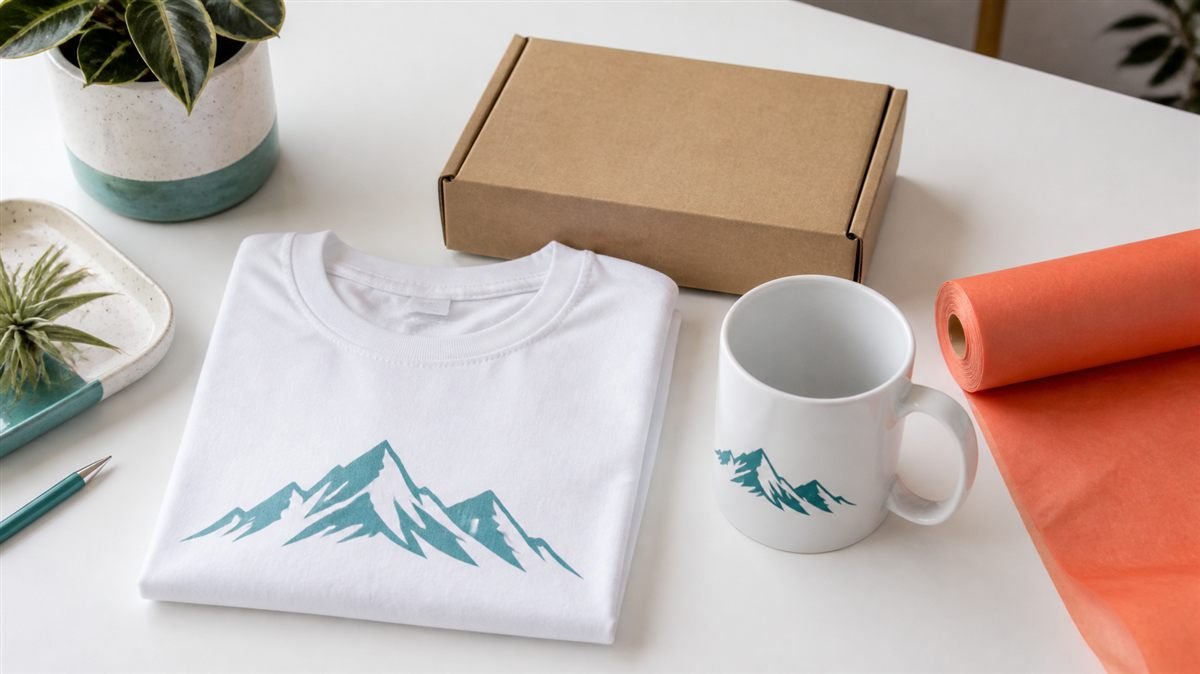
Print on demand (POD) means you create the design and a production partner prints it onto a blank product only after someone orders it. The partner then packs the order and ships it to your buyer. You never hold stock.
A typical POD order on Etsy works like this:
What Etsy requires: POD items count as "designed by a seller". The design must be your own, and you must disclose the production partner in your shop and listings, including where the item ships from.
Where POD works well: designs built for a clear audience, such as a hobby, a profession, a pet breed, a hometown or a life event. A teacher, a nurse or a fan of a niche hobby will buy a design that speaks to them, even when the blank product is ordinary.
What to watch:
Our Etsy print on demand service covers niche research, product choice and listings for POD shops.
Digital products are files the buyer downloads after paying: printable wall art, planners, templates, SVG cut files, invitations, worksheets, spreadsheets. Etsy delivers the file automatically, so there's nothing to make, pack or ship.

What Etsy requires: digital downloads count as "designed by a seller", so the file must be your original work. A bundle, scan or PDF of someone else's work isn't allowed. If you used AI to create the item, you must say so in the listing description. AI prompt bundles aren't allowed either.
Where digital works well: buyers who need something useful quickly. Teachers want classroom resources, small businesses want templates, and people planning events want invitations and signs. A digital product that solves a specific job sells better than a generic "aesthetic" design.
What to watch:
See our Etsy digital products service if you want help choosing and positioning a digital range.
Private label means a manufacturer produces a product for you, and you sell it under your own brand name. Think skincare, candles, jewelry, bags or home goods with your label, your packaging and your story.
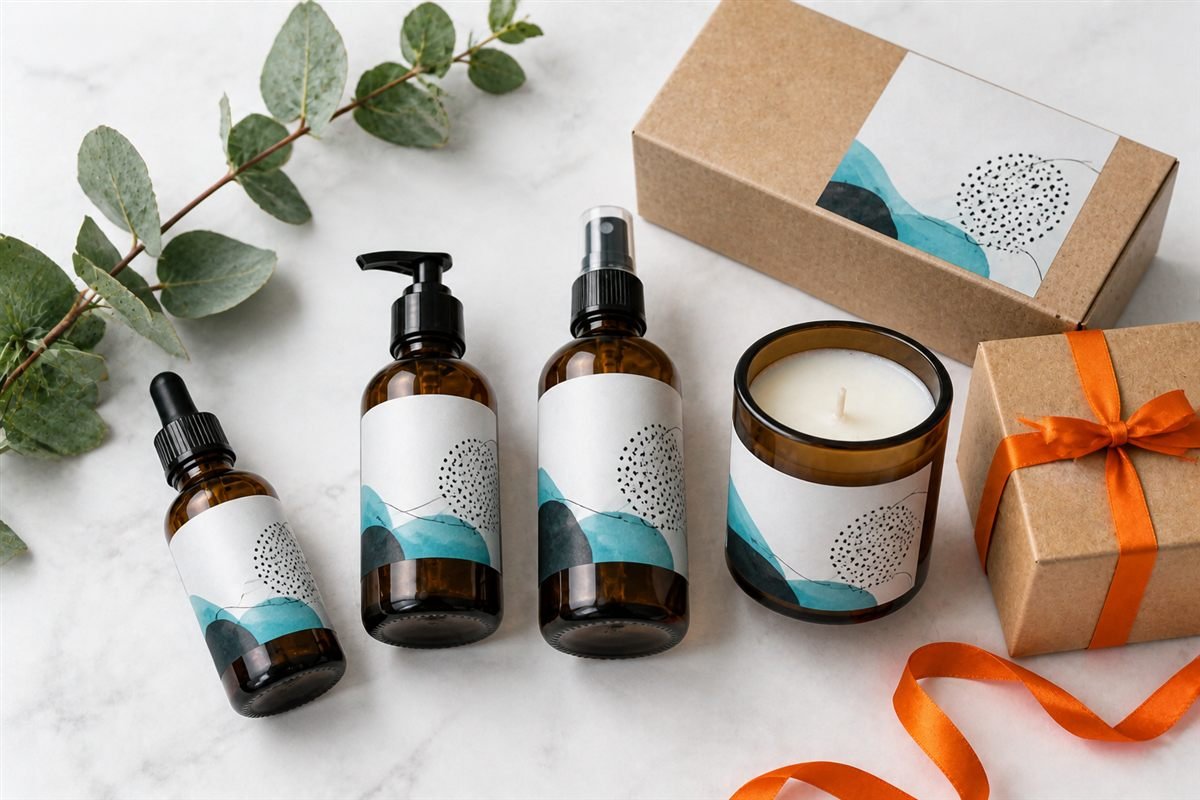
On Etsy, private label only works in one form. The product has to be your own design or made to your own specification, and the manufacturer must be disclosed as your production partner. Etsy's own example is a dress designed by a seller and reproduced at scale by a production partner. Choosing a stock product from a supplier's catalog and adding your logo doesn't meet that standard.
Where private label works well: sellers who want to build a real brand with a consistent product, better margins per sale and room to grow beyond Etsy later.
What to watch:
Our Etsy private label service covers product research, positioning and listings for private label brands.
Handmade is the model Etsy started with: you make the product yourself, by hand or with tools in your own workspace. Etsy counts items produced at home with computerized tools such as a laser cutter or 3D printer as "made by a seller" too, as long as they come from your own design.

Handmade gives you full control over quality and the strongest story to tell buyers. The limit is time. Every order needs your hours, so growth stops at the number of items you can make. Many handmade sellers add a second model later, for example a potter selling prints of their glaze patterns, or an illustrator selling originals alongside POD prints.
| Print on demand | Digital products | Private label | Handmade | |
|---|---|---|---|---|
| Who makes it | Print partner | Nobody (a file) | Manufacturer | You |
| Etsy category | Designed by a seller | Designed by a seller | Designed by a seller | Made by a seller |
| Inventory | None | None | Usually yes | Materials, sometimes stock |
| Upfront cost | Low (samples, design) | Low (software, time) | Higher (samples, MOQ, packaging) | Varies (tools, materials) |
| Shipping | Partner ships | Instant download | You or a fulfillment service | You |
| Margin per sale | Usually lower | High once created | Usually higher | Depends on your time |
| Main limit | Competition and margins | Low prices and saturation | Cash and supplier quality | Your hours |
These are general patterns, not promises. Your real costs and margins depend on your product, your suppliers and your prices, so do the numbers for your own idea before you commit.
Answer these four questions honestly. They usually point to one model quickly.
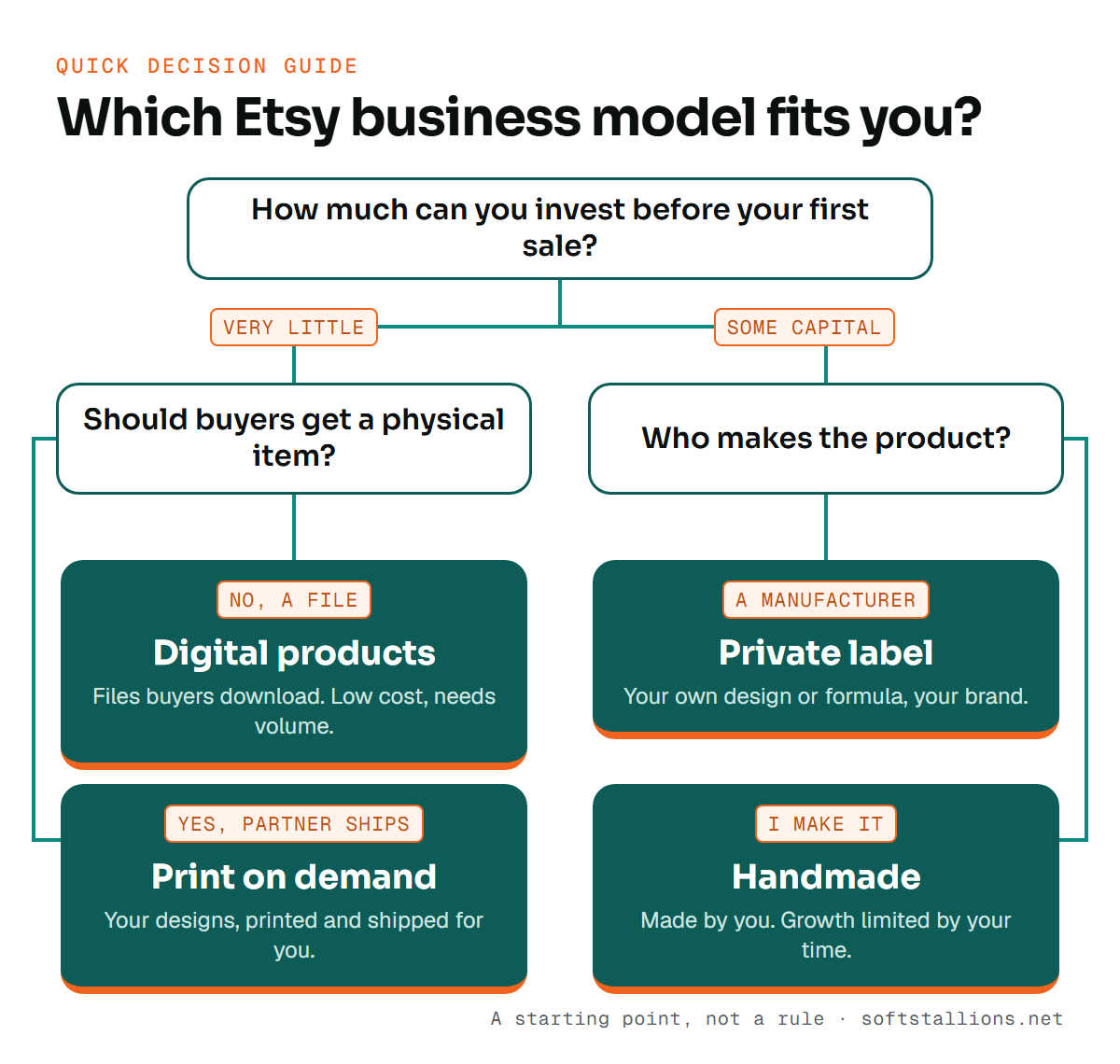
One example: a graphic designer with a small budget and a full-time job usually does best with digital products or POD. They can build listings in the evenings and never handle stock. A founder with a tested skincare formula and some capital is a private label case. They need a manufacturer, compliant labels and a brand that earns repeat orders.
Once you've picked a model, start here. Each list follows the order we'd work through it with a client.
Yes. Etsy lets one shop sell items from different categories, as long as each listing follows the rules for its own type. Combinations that often make sense:
Keep each listing clear about what the buyer receives, and disclose production partners wherever you use them. Buyers who expect a physical item and receive a file leave bad reviews quickly.
Yes. Etsy allows print on demand when the design is your original work and you disclose your production partner in your listings.
Yes, if the product is made to your own original design or specification by a manufacturer you disclose as a production partner. Reselling a supplier's ready-made product with your logo added does not meet Etsy's Creativity Standards.
Digital products and print on demand usually cost the least to start, because you don't buy stock. Expect to spend time on design and some money on samples or software.
Not in the usual sense. Reselling items from a supplier that you didn't make or design is not allowed. Print on demand of your own designs is the permitted way to have a partner ship orders for you.
Yes. Etsy requires you to disclose in the listing description when an item was created with the use of AI.
Free consultation · USA & worldwide
Tell us what you want to sell and what you can invest. We'll show you which model fits, what the numbers look like after Etsy's fees, and the fastest safe route to your first sales.
Or see the service for your model: Print on Demand · Digital Products · Private Label · Shop Setup & Launch
Our Etsy shop setup guide walks you through every screen: preferences, shop name, payments, setup fee, ID check, 2FA, storefront and first listings.
How to sell on Etsy in 2026: what you need, how to open your shop, the 8 steps to your first sales, fees by country and the mistakes…