What to Sell on Etsy in 2026: Product Ideas With Real Demand
What to sell on Etsy in 2026: product ideas that suit Etsy buyers, what the Creativity Standards allow, what to avoid and how to test an idea first.
Etsy marketplace consultancy for businesses in the USA and worldwide.
Etsy product research in 9 steps: collect real search phrases, read page one, check the rules, work out profit after fees, then test a small batch.
Part of: What to Sell on Etsy in 2026: Product Ideas With Real Demand
In short: Etsy product research is the process of proving that a product will sell before you make it. Set your limits first, generate ideas from buyers and occasions, collect the phrases shoppers type in Etsy search, study the first page of results, check the rules, work out your profit after Etsy's fees, check seasonality, define what makes your version better, then test a small batch and read your Stats. Each step removes weak ideas cheaply.
Last updated: 5 November 2026. Rules, fees and tools checked against Etsy's Creativity Standards, Fees & Payments Policy, Intellectual Property Policy, Etsy Help's How to Use Etsy Stats and Marketplace Insights guide.
Most products that fail on Etsy were never researched. They were made because the seller liked them, or because a similar listing looked popular. Product research doesn't guarantee a winner. It does stop you spending weeks and money on ideas that never had a chance. Below is the step-by-step method we use with clients, using free Etsy tools first and paid tools only where they save time. It suits new sellers choosing a first range and established shops adding new products.
Etsy product research is the work of checking four things about a product idea before you invest in it:
Niche research picks the buyer. Product research picks what you sell to that buyer. If you haven't chosen your buyer yet, start with our guide to Etsy niche research.
You can do most of this with free tools. Here is what each one is good for:
| Tool | Cost | Best for |
|---|---|---|
| Etsy search bar suggestions | Free | The exact phrases shoppers type |
| Etsy search results and listings | Free | Competition, prices, photo quality, recent reviews |
| Marketplace Insights (Shop Manager, Stats) | Free with a weekly limit, more with Etsy Plus | Recent Etsy search and listing counts for a keyword, related terms |
| Your shop's Stats | Free | Search terms, views, favorites and sales on your own listings |
| Google Trends | Free | Seasonality and long-term direction |
| Third-party Etsy research tools | Usually paid | Speed and estimates across many listings |
Third-party tools that estimate a listing's sales or revenue are making educated guesses. Use them to spot patterns, not as proof.
Work through these nine steps in order. Most ideas should drop out somewhere in the middle. That's the method working.
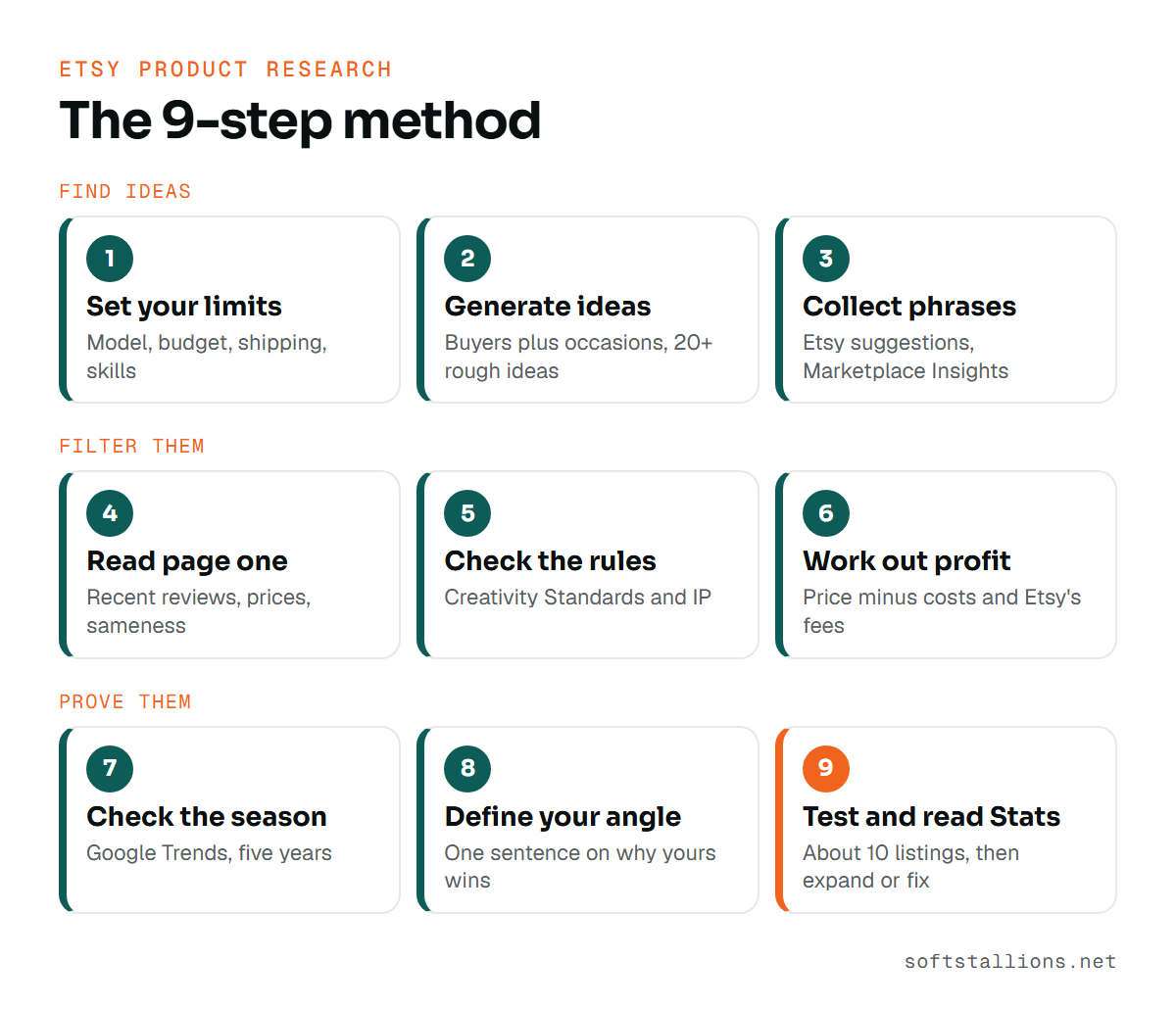
Write down what you can actually do before you look for ideas. Which business model are you using (handmade, print on demand, digital or private label)? What can you spend on samples or stock? Where will products ship from, and how long can delivery take? What skills and equipment do you have? Ideas that break these limits aren't ideas for you right now.
List the buyers in your niche and the moments when they buy: birthdays, weddings, new babies, holidays, a new job, a new hobby, a new home. For each pair, list products that would make sense. Aim for twenty or more rough ideas, and don't judge them yet. The next steps will do that.
For each idea, type the main phrase into Etsy search and write down the suggestions. Add buyer words, occasions, styles and materials to reveal more. Then check your best phrases in Marketplace Insights to see recent Etsy search and listing counts. Keep a short list of phrases that are specific and clearly used by shoppers.
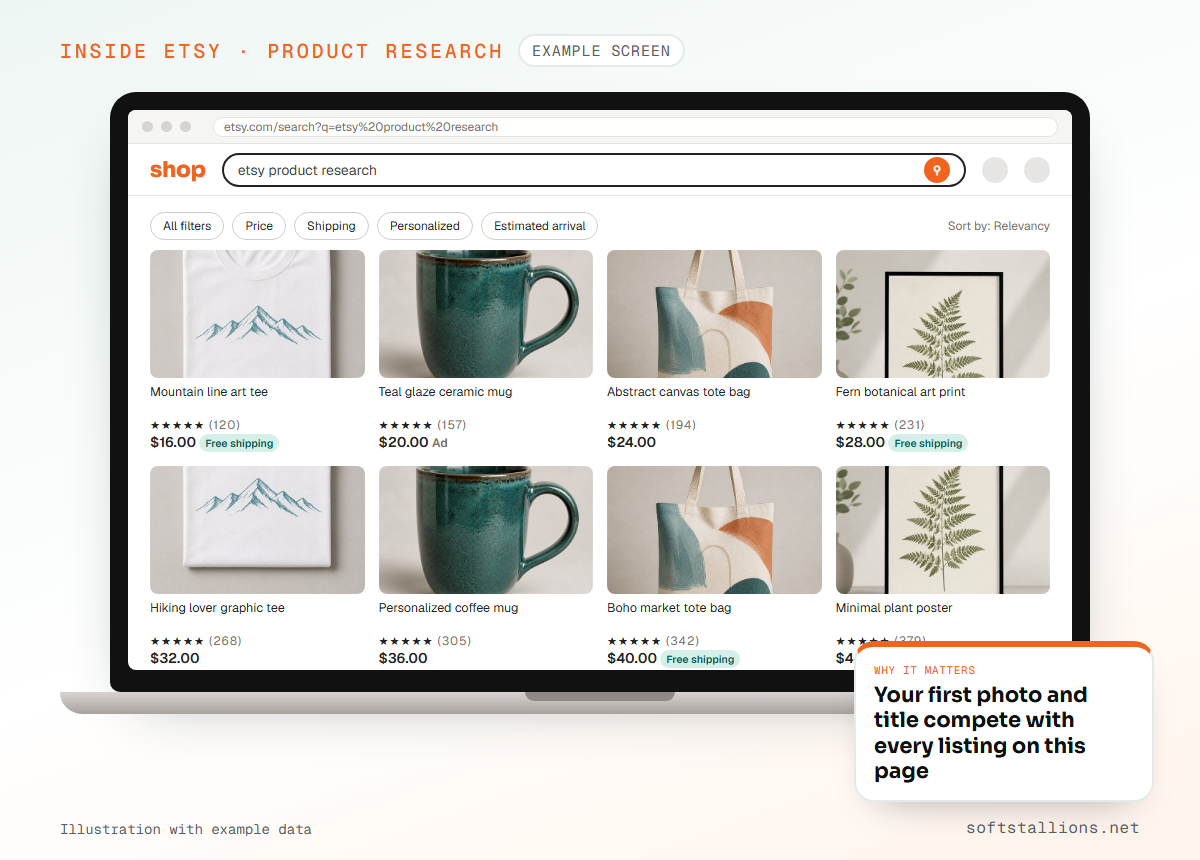
Search each shortlisted phrase and study the first page. Record, for each idea:
Recent reviews across several listings are your best free sign of current demand. A first page of near-identical listings means buyers choose on price.
Confirm the product fits one of the four groups in Etsy's Creativity Standards. Reselling mass-produced items isn't allowed. If you use a production partner, you must disclose it with an accurate dispatch location. If AI helped create the design, say so in the description. Then check the idea for intellectual property problems. Brand names, characters, team logos and song lyrics are the usual reasons listings get removed. See our guide to trademarks and copyright on Etsy.
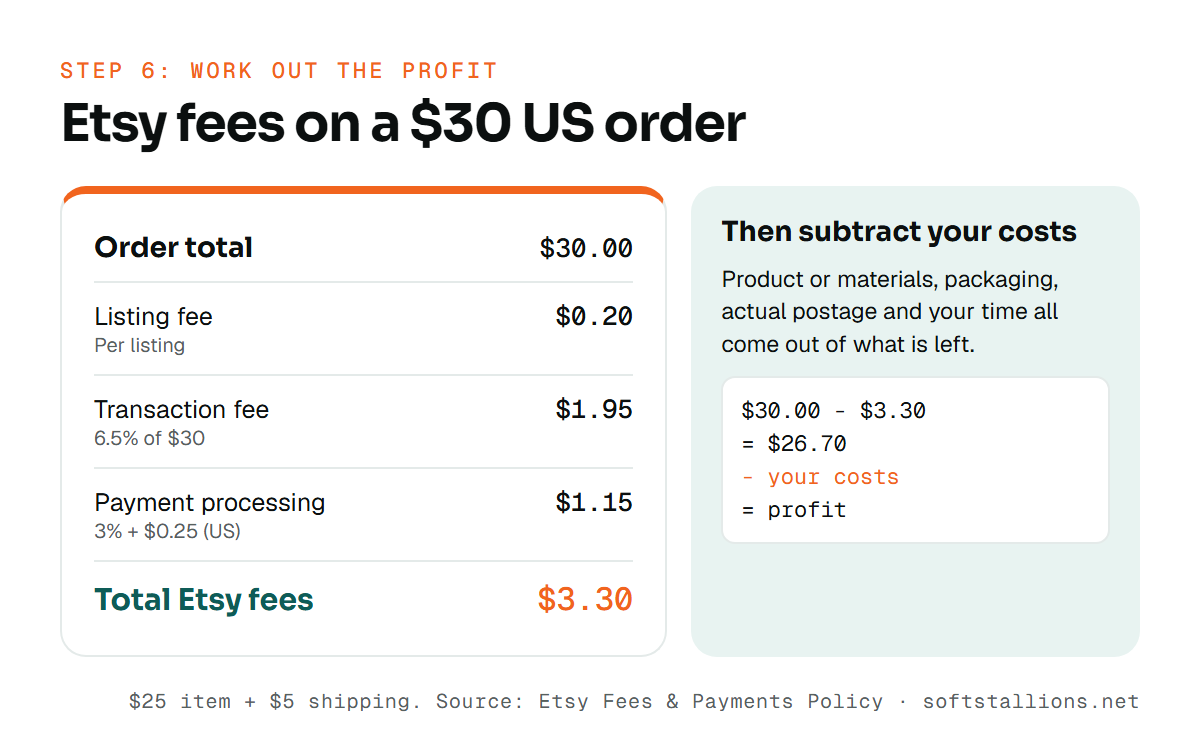
Take the typical price on the first page and subtract every cost. Etsy charges $0.20 per listing, a 6.5% transaction fee on the item price plus shipping and gift wrap, and a payment processing fee that depends on your bank's country. US sellers pay 3% + $0.25. Add the Offsite Ads fee to your worst case if your shop is enrolled, since it applies to orders that come from Etsy's ads on other sites.
For a US seller, a $30 order (a $25 item plus $5 shipping) costs $3.30 in Etsy fees. Your product cost, packaging and actual postage come out of the remaining $26.70. Our Etsy fee calculator does this sum for any price. If what's left doesn't pay for your time, the idea fails here.
Look up the main phrase in Google Trends for your buyers' country over five years. You want to know whether demand is steady, seasonal or fading. Seasonal products are fine, but they change when you need to list and how many months of the year the product earns. Our guide to Google Trends for Etsy explains how to read the charts.
Write one sentence on why a buyer should choose your version over the first page. Good angles are concrete: a style nobody offers, a size or format buyers ask for in reviews, easier personalization, better materials, faster dispatch, a more specific buyer. "Better quality" on its own isn't an angle, because every seller claims it.
Launch the ideas that survive as a focused batch, around ten listings, each aimed at a different phrase or angle. Give each one strong photos, a clear title, all 13 tags and complete attributes. After a few weeks, open your Stats and check views, the search terms bringing visitors, favorites and orders. Expand what works and fix or remove what doesn't.
Your Stats tell you where the listing is failing, which tells you what to fix:
| What you see | Likely problem | What to try |
|---|---|---|
| Very few views | Not found in search | Titles, tags and attributes that match the phrases you researched |
| Views but few favorites | First photo or price does not appeal | A clearer first photo, then check your total price against page one |
| Favorites but no orders | Doubts at the decision point | Description, shipping cost, delivery time, reviews, personalization steps |
| Steady orders | The product works | Add variations, related products and seasonal versions |
Change one thing at a time on a listing so you can see what helped.

The nine steps apply to every model, but the weight of each step changes:
Use one spreadsheet for every idea, with a row per idea and a column for each step: buyer, occasion, main phrases, Marketplace Insights numbers, recent reviews on page one, price range, rules check, profit, seasonality, angle and test result. Add the date you checked, because Etsy results change.
The sheet does two jobs. It stops you from re-researching ideas you already rejected, and it shows you patterns over time, such as which buyers or price ranges keep passing. Revisit the rejected ideas each season. An idea that failed on seasonality in spring can be right for autumn.
If you'd like experienced eyes on your ideas, our Etsy product research service runs this full method for you, and our competitor analysis service goes deeper on the shops you'll face.

Look for search phrases Etsy suggests, then check the first page of results for listings with recent reviews. Products with recent reviews across several shops are selling now.
Yes, Etsy sellers can use Marketplace Insights in Shop Manager under Stats, with a limit on keyword searches each week. Etsy Plus subscribers get more searches.
No. Free Etsy tools and Google Trends cover the full method. Paid tools can speed up research, but their sales figures are estimates.
Around ten listings for one buyer is a good first batch. It gives you enough data to compare angles without spreading your time too thin.
Check your main products each season and before each big selling period. Search behavior, competition and prices on Etsy change through the year.
Free consultation · USA & worldwide
We run the full research method on your ideas: demand, competition, rules, margins and seasonality. You get a ranked shortlist and a first batch plan you can launch.
Or see: Etsy product research · Etsy competitor analysis · Etsy keyword research · Etsy consulting
What to sell on Etsy in 2026: product ideas that suit Etsy buyers, what the Creativity Standards allow, what to avoid and how to test an idea first.
Etsy competitor analysis step by step: find shops that rank for your keywords, break down their listings and reviews, track gaps and improve without copying.
How to use Google Trends for Etsy: read the 0-100 scale, spot seasonal and fading demand, find rising angles and confirm every idea in Etsy search first.