What to Sell on Etsy in 2026: Product Ideas With Real Demand
What to sell on Etsy in 2026: product ideas that suit Etsy buyers, what the Creativity Standards allow, what to avoid and how to test an idea first.
Etsy marketplace consultancy for businesses in the USA and worldwide.
Etsy competitor analysis step by step: find shops that rank for your keywords, break down their listings and reviews, track gaps and improve without copying.
Part of: What to Sell on Etsy in 2026: Product Ideas With Real Demand
In short: Etsy competitor analysis means studying the shops and listings that appear for your buyers' searches, so you can see what buyers respond to and where you can do better. Find your real competitors by searching your main keywords, review their shop basics, then break down their listings: photos, titles, prices including shipping, options, descriptions and reviews. Record it in a simple tracker, look for gaps and turn them into improvements. Learn from competitors, but never copy their designs, photos or text.
Last updated: 4 November 2026. Rules checked against Etsy's Intellectual Property Policy, Creativity Standards and Fees & Payments Policy, plus Etsy Help's Marketplace Insights guide.
Every Etsy search result is a small market. The listings above yours are the ones buyers compare you with, and they're already showing you what works for that search. Studying them carefully is one of the cheapest ways to improve your own shop. This guide is for new sellers checking a niche before launch, and for established shops whose sales have stalled. We'll walk through a repeatable method, the details worth recording and where the line sits between learning and copying.
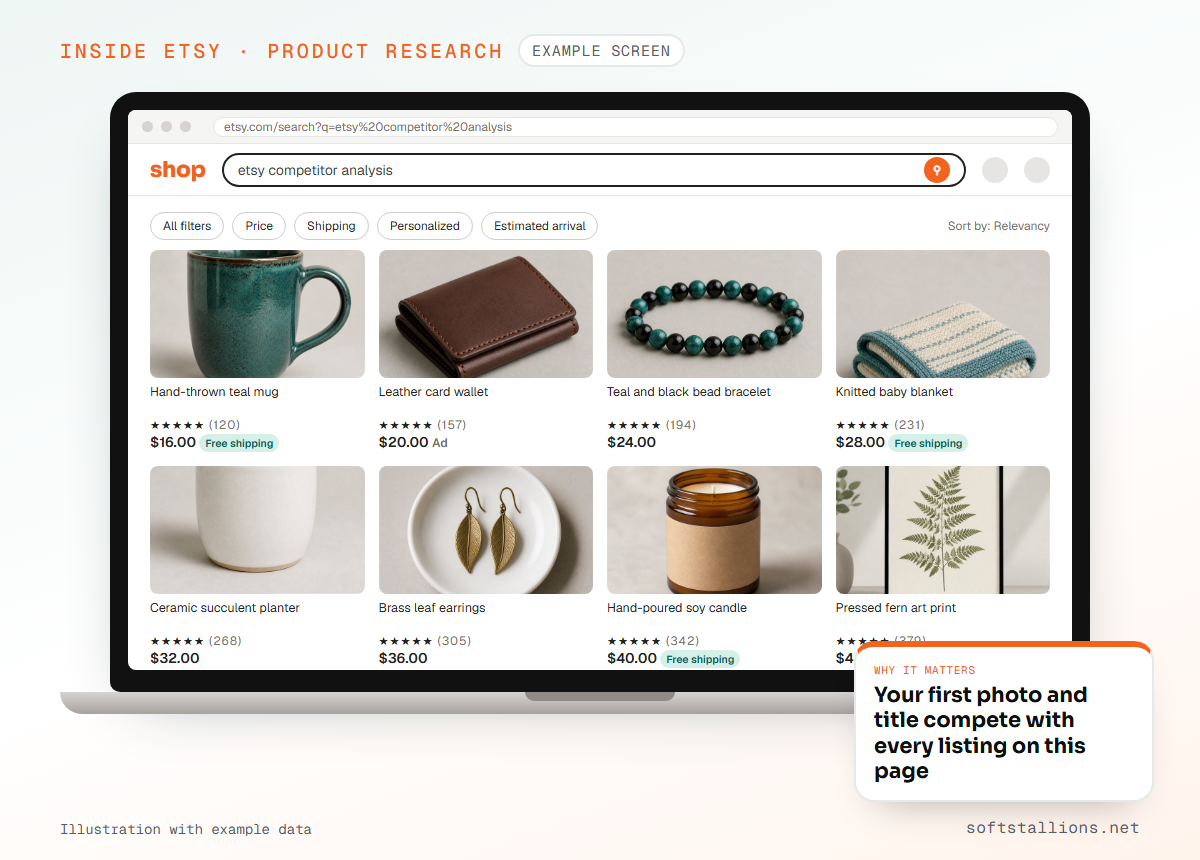
Etsy competitor analysis is a structured look at the shops and listings that compete for the same buyers and searches as you. It answers four questions:
The goal isn't to become a copy of the top shop. It's to understand the standard buyers expect and then find a reason for them to choose you.
Your competitors aren't the biggest shops in your category. They're the shops that appear for the searches you want to win. A small shop ranking first for "personalized dog memorial ornament" competes with you more directly than a famous shop selling general home decor.
There are two kinds to track:
Use Etsy itself. It shows you exactly what buyers see.
Search while signed out or in a private browser window as well, since results can vary between shoppers.
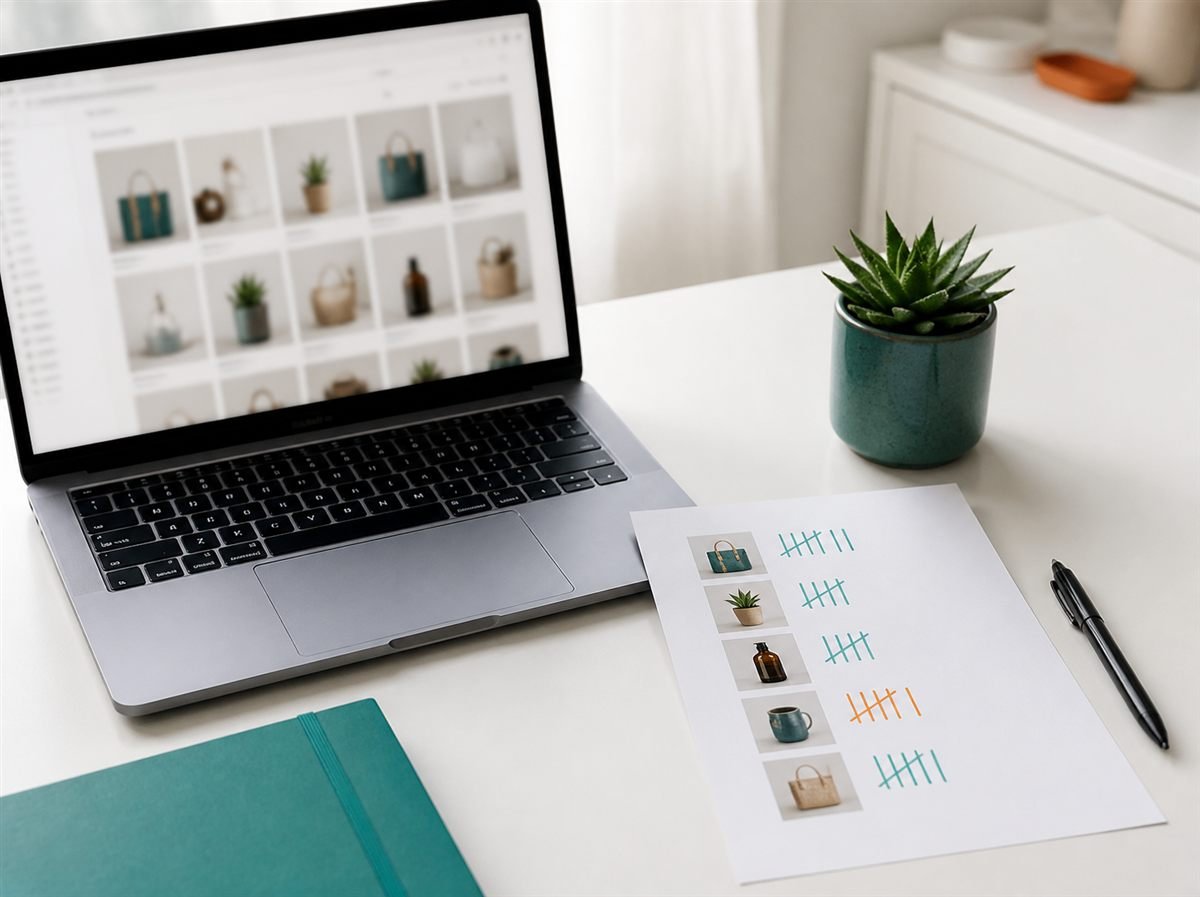
Start with the shop page. It tells you how established the shop is and how it presents itself.
Don't treat reviews as sales. Many buyers never leave a review, so review counts show direction rather than exact numbers.
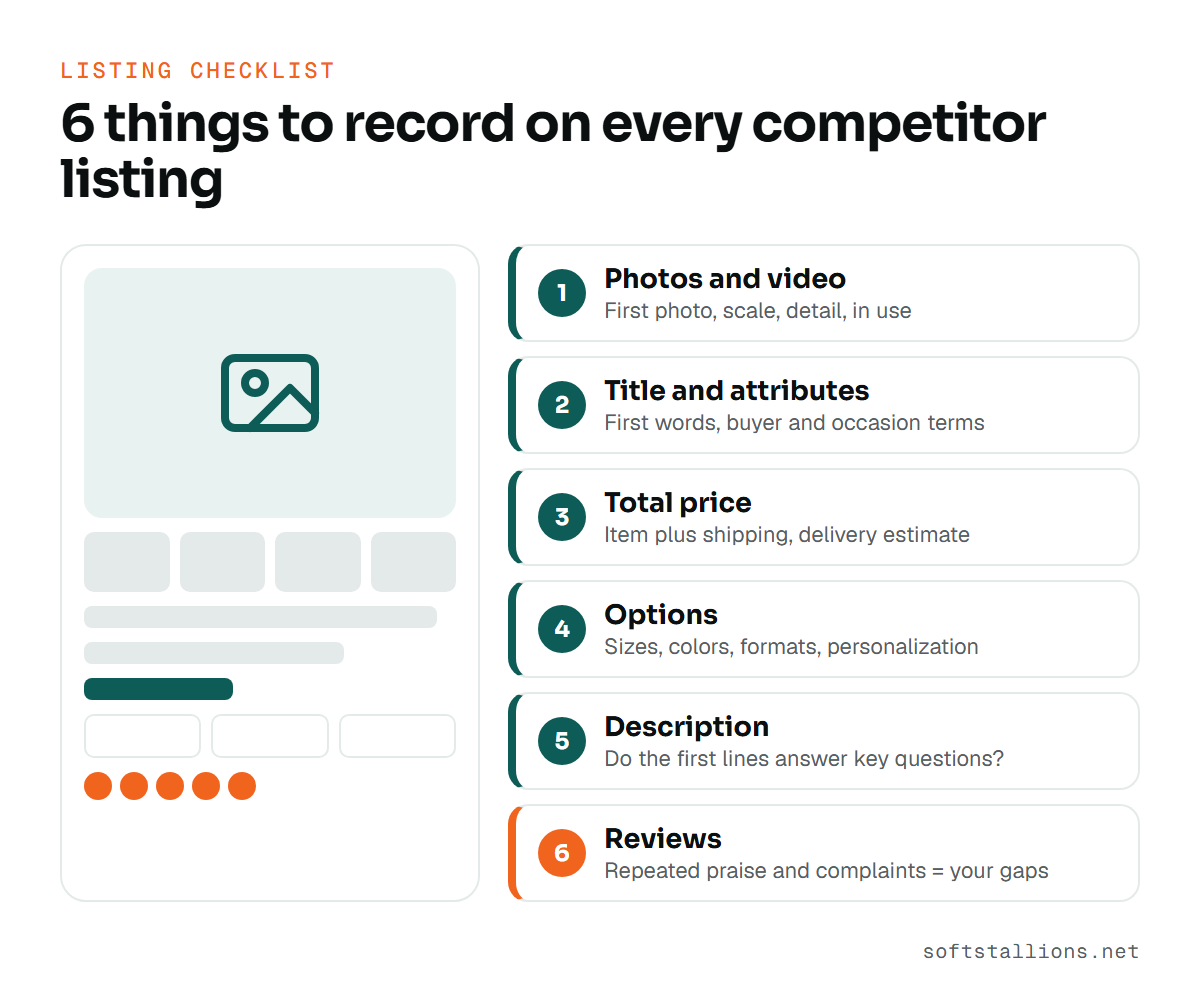
Pick each competitor's two or three best-ranked listings for your keywords. Go through each one with the same checklist so your notes are comparable.
What does the first photo show, and how does it look as a small thumbnail? How many photos do they use? Do they show scale, detail, the product in use, personalization examples and packaging? Is there a video?
Which words come first in the title? Which buyer, occasion or style words do they include? You can't see their tags, but the title and the attributes filled in (color, material, occasion, holiday) tell you which searches they target.
Record the item price, the shipping cost to your main market and the delivery estimate. Buyers compare the total, so you should too.
Note the sizes, colors, formats and personalization fields. Check how easy the personalization instructions are to follow.
Does the first paragraph answer the main questions about size, materials, personalization and delivery? Are there care instructions, sizing guides or file details for digital items?
Read the listing's recent reviews and note any repeated praise or complaints. This is where most gaps appear.
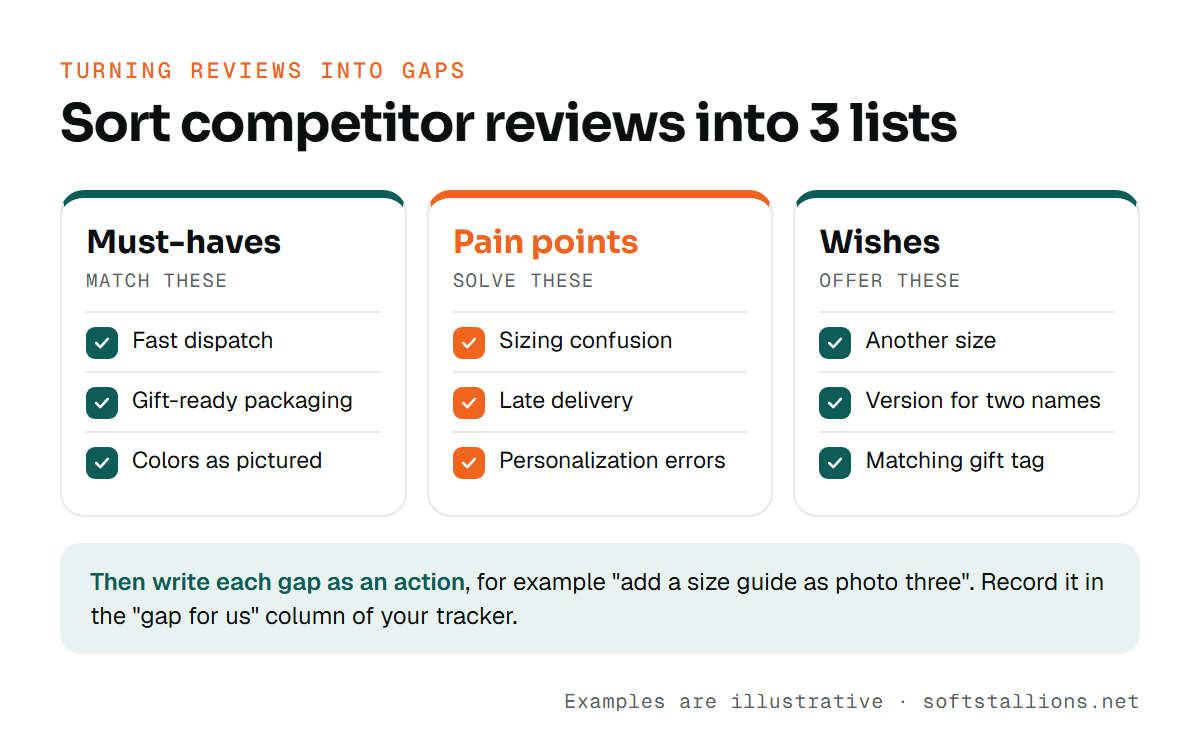
Reviews are buyers telling you what matters to them. Read twenty or thirty recent reviews across your competitors and sort what you find into three lists:
A gap that appears across several competitors is worth more than one complaint about a single shop. Write each gap as an action, for example "add a size guide image as photo three" or "offer a matching gift tag".
Compare like with like. For each competitor listing, record the total a buyer in your main market pays: item price plus shipping. A $22 item with free shipping and an $18 item with $6 shipping aren't what they first seem.
Then check what that price leaves you. Etsy charges a 6.5% transaction fee on the item price plus shipping, a $0.20 listing fee and a payment processing fee that depends on your bank's country. For a US seller, a $30 order costs $3.30 in Etsy fees before product, packaging and postage. If you can only win by being the cheapest, look for a different angle instead. Our guide on how to price on Etsy covers this in detail.
A simple spreadsheet is enough. One row per competitor listing, with columns like these:
| Column | What to record |
|---|---|
| Keyword | The search where you found the listing |
| Shop and listing | Shop name and listing link |
| Shop scale | Sales or review count, year opened, Star Seller |
| Total price | Item price plus shipping to your main market |
| First photo | What it shows and how it reads as a thumbnail |
| Title focus | The first words and the buyer or occasion words used |
| Options | Sizes, colors, formats, personalization |
| Review themes | Repeated praise and complaints |
| Gap for us | The one improvement you could offer |
| Date checked | When you recorded it |
The "gap for us" column is the reason the sheet exists. Every row should end with an action you could take.
Learning from competitors is normal business. Copying them is a problem, on Etsy and in law. Sellers are responsible for having the rights to everything they list, Etsy removes listings reported for infringement, and repeat infringement can end selling privileges. Don't copy:
What you can learn freely is the general standard: that buyers in this niche expect a size guide, that a lifestyle first photo outperforms a flat one, that personalization instructions need to be simple. Use those lessons with your own work. Our guide to trademarks and copyright on Etsy covers the rules in more depth.
Do a full analysis before you enter a niche or launch a new product line. After that, a light check works well:
If you'd rather have this done with a full report, our Etsy competitor analysis service studies the shops in your niche and turns the findings into a list of changes, and our listing optimization service can then apply them. For choosing what to sell in the first place, see our Etsy product research method.
Many shops display a sales count on their shop page next to their reviews. For individual listings, Etsy doesn't publish exact sales, so third-party tools show estimates only.
Etsy doesn't display a listing's tags as a list for shoppers. You can infer the searches a listing targets from its title, attributes and the keywords it ranks for.
Copying another seller's designs, photos or text can infringe their rights, and Etsy removes listings reported for infringement. Learn from what works and create your own version.
Five to eight shops is usually enough for one niche. Choose those that appear across several of your main keywords, including some smaller shops.
No. Etsy search, shop pages, listing pages and reviews give you most of what you need. Paid tools speed things up, but their sales numbers are estimates.
Free consultation · USA & worldwide
We study the shops that rank for your keywords and turn what we find into a clear list of changes for your listings. No copying, just the gaps your buyers are telling us about.
Or see: Etsy competitor analysis · Etsy listing optimization · Etsy shop optimization · Etsy product research
What to sell on Etsy in 2026: product ideas that suit Etsy buyers, what the Creativity Standards allow, what to avoid and how to test an idea first.
Etsy product research in 9 steps: collect real search phrases, read page one, check the rules, work out profit after fees, then test a small batch.
How to use Google Trends for Etsy: read the 0-100 scale, spot seasonal and fading demand, find rising angles and confirm every idea in Etsy search first.